Understanding Anti-Free Black Policies in Georgia: A Deep Dive
Updated: Apr 12
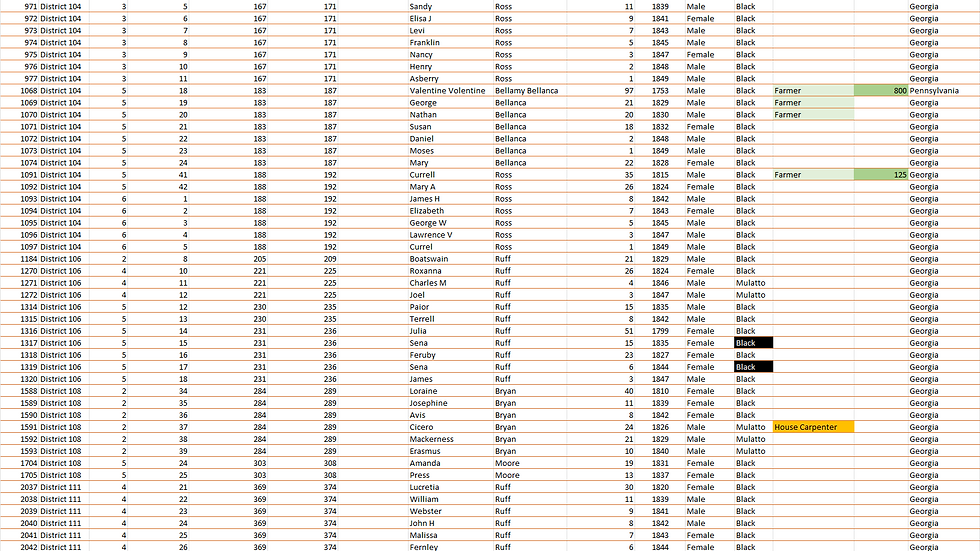
Here’s a clear, chronological list of the main state-level anti-free Black policies (often called “free Negro laws”) enacted in Georgia during the antebellum period (roughly 1800–1860). These laws were designed to tightly control, discourage, and shrink the free people of color (FPOC) population. They made daily life difficult, restricted new arrivals, and threatened re-enslavement. This explains much of the sharp local declines you saw in counties like Hancock (and neighboring Baldwin/Milledgeville) between the 1850 and 1860 censuses.
Many of these laws were enforced locally through county Courts of Ordinary, which kept Free Persons of Color Registers. Surviving records exist in 21 Georgia counties, including Hancock. Counties and cities often added extra burdens, such as high head taxes or residency fees.
Key Anti-Free Black Policies in Georgia

1801 Manumission Ban
Manumission (freeing a slave) was outlawed except by a special act of the legislature. Clerks were forbidden to record any deed of manumission. Violators faced heavy fines (over $200). This made it extremely difficult to create new free Blacks.
1815–1818 Manumission Tightening
Further prohibitions on recording manumissions were enacted, and fines were raised to $500. Freed people were often required to leave the state or risk being sold back into slavery.
1818–1819 Annual Registration Law
Every free person of color had to register once a year (by March 1) with the clerk of the Inferior Court (later Court of Ordinary) in their county. They had to list their name, age, family members, residence, occupation, property, and usually name a white “guardian” or sponsor.
The penalty for non-registration included fines, imprisonment, or even sale into slavery. This law was statewide and remained in force until the Civil War. Failure to comply was a common way people disappeared from the records.
Property & Slave Ownership Ban (Early 1800s Onward)
Free persons of color were forbidden to own real estate or slaves in many statutes.
1829 Anti-Literacy Laws
Teaching any Black person (free or enslaved) to read or write became illegal.
Whites faced fines up to $500 and imprisonment.
Free Blacks or slaves faced fines, whipping, or both.
Disseminating “insurrectionary literature” (like David Walker’s Appeal) was a capital offense.
Religious & Assembly Restrictions (1770–1830s)
No more than seven persons of color (free or slave) could meet for religious services without white supervision. Broader limits on unsupervised gatherings applied.
1859 Entry/Immigration Ban
“An Act to prevent free persons of color from being brought into the state” was enacted.
Any free Black entering Georgia (except seamen) could be sold into slavery.
Anyone aiding or transporting them faced a minimum $1,000 fine and possible imprisonment.
The burden of proof was on the free Black person.
This was one of the harshest late-antebellum measures and coincided with the biggest drops in FPOC numbers.
Local Taxes, Vagrancy, and “Guardian” Fees
Counties (including Hancock) imposed special head taxes or residency fees on free Blacks (often $50+ per adult—enormous for the era). Non-payment or failure to post a bond could lead to arrest and sale into temporary slavery. Many registers also required a white sponsor who could be held liable.
General Legal Status (Repeatedly Affirmed)
Free Blacks were not considered citizens. The 1842 legislature declared they were “in a state of pupilage” and “regarded as our wards.” They had almost no political rights, limited court testimony rights against whites, and were subject to the same patrol and vagrancy systems used against enslaved people.
These policies created a climate of constant surveillance, financial pressure, and fear. By the 1850s, many free Black families in rural Black-Belt counties like Hancock simply could not (or chose not to) comply. They either left the state, “disappeared” from records, or were forced out—producing the exact 65-to-13 drop you observed in the census excerpts.
If you’d like the exact text of any specific law, links to the surviving Hancock County Free Persons of Color Registers, or how these applied to the Ruff/Ridley/Ross families in your tables, just let me know!
1850 Free People of Color
The households in the tables (the Ruffs, Ridleys, Rosses, Shaps, Bellancas, Bryans, etc.) were the resilient core—often mulatto, with skilled occupations like tailor, cook, washer/ironer, house carpenter, and farmer. In a few cases, they even had modest real or personal estate. They were the exceptions who could navigate the registration/tax system and stay afloat.
After emancipation in 1865, the Black population in Hancock rebounded dramatically as freed people remained or returned. Hancock County’s Free Persons of Color Registers (available on microfilm or FamilySearch) likely list many of the same surnames you see. These records could provide more details on who registered (or stopped registering) between 1855–1862.
In short, the 65 → 13 plunge was engineered by a combination of state and local anti-free-Black policies in one of Georgia’s most plantation-heavy counties. It’s a classic example of how the 1850s “hardening” of the slave regime squeezed out even the small free-colored communities.
Let the ancestors speak...
---wix---


Comments